A science-led guide to why blended peptide stacks are a different question than the compounds themselves — and what you give up when you buy one vial instead of several.
If you’ve spent any time researching peptides, you’ve run into the blends. GLOW. KLOW. A dozen variations, all promising the convenience of one vial instead of three — one order, one price, one injection routine instead of juggling separate schedules.
The appeal is real. Convenience is a legitimate thing to want. But “convenient” and “sound” are two different questions, and the blend format quietly answers only one of them.
Here’s what actually happens when compounds are pre-mixed into a single vial at a fixed ratio — and why that fixed ratio is the whole problem, whether or not the chemistry itself holds up.
The chemistry question
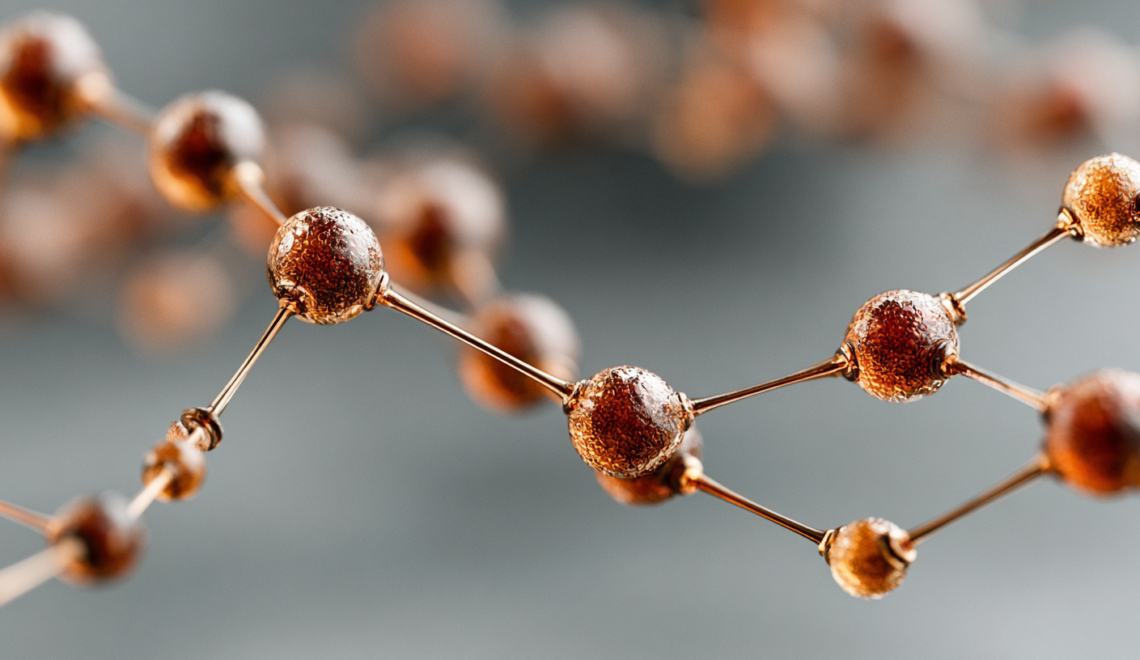
Copper peptide — GHK-Cu — is the clearest example, because it’s a genuinely different kind of molecule than the peptides it’s often blended with. It’s not just a chain of amino acids; it’s a copper ion held inside that chain in a tight chemical complex.1
That copper center is real and it’s reactive. Copper is a legitimate catalyst for oxidation, and formulation guidance for GHK-Cu is consistent on this point: keep it away from strong oxidizers, low pH, and competing metal ions, because those conditions can degrade both the copper complex and whatever else is in the same solution.2 That’s a genuine, chemistry-grounded reason to think carefully about what GHK-Cu sits in a vial with.
But “think carefully about it” is not the same as “it destroys anything it touches,” and that’s where a lot of the mixing advice you’ll find overstates the case. GHK-Cu is formulated alongside other peptides and actives constantly — at the right pH, away from strong oxidizers, it coexists just fine.3 The honest version is narrower and more useful than either extreme: the risk is real, it’s specific to certain conditions, and it’s manageable with the right handling — not a blanket reason to declare all mixing unsafe.
The question the chemistry can’t answer
Here’s the deeper problem, and it’s one that exists even when two compounds are perfectly stable together in the same vial.
Once compounds are pre-mixed at a fixed ratio, that ratio is permanent for the life of the vial. You cannot take more of one and less of the other. You cannot adjust either independently as your research interests or your own tracked response changes. Whatever ratio the manufacturer chose is the only ratio you have access to, every time you draw from that vial.
This matters more than it might seem, because even compounds that are considered perfectly compatible to run together are still often adjusted on separate timelines. It’s common practice, for instance, to taper one compound down to a lower maintenance level while continuing a second compound alone for several additional weeks.4 That kind of independent adjustment — tapering one, holding steady on another — is simply not possible once they’re combined in one vial. You’d have to discard the blend and start over with separate compounds to do it at all.
That’s the part a blend can’t sell you around: it’s not just a question of whether two compounds get along chemically. It’s that combining them removes a kind of control you may not know you’re giving up until you actually want to use it.
What the research actually shows
| What We Know | GHK-Cu’s copper center creates a genuine, chemistry-grounded oxidation risk under specific conditions (strong oxidizers, low pH, competing metal ions). Pre-mixed blends lock in a fixed ratio that cannot be adjusted, and standard practice for even well-tolerated compound pairings often involves independently tapering one while continuing the other. |
| What We Don’t Know | Whether any specific commercial blend’s actual formulation conditions (pH, storage, exposure to light and air) result in meaningful degradation by the time it reaches a buyer — that depends on manufacturing practices this article can’t verify for any given product. Independent, published testing comparing pre-mixed blends against freshly combined single compounds is not publicly available. |
| What That Means | The strongest argument against blends isn’t that they’re chemically doomed — some combinations are genuinely fine. It’s that a fixed-ratio vial permanently removes your ability to adjust, taper, or personalize dosing of each compound independently, which is a real cost regardless of how the chemistry shakes out. |
What this means for you
If you’re comparing a blend against buying compounds separately, the real question isn’t just “will these two things get along in one vial.” It’s “will I want to adjust one of these independently of the other, at some point, without having to throw out what I already bought and start over.”
For almost anyone tracking their own response over time, the answer to that is yes. That’s the actual argument for single-compound vials over blends — not a scare story about chemistry, but a straightforward point about control: you keep the ability to adjust each compound on its own terms, for as long as you’re doing this.
Sources
1. Copper peptide GHK-Cu — structure and copper coordination chemistry. Wikipedia / peer-reviewed structural chemistry literature.
2. GHK-Cu Copper Peptide: A Guide for Formulators. Parchem. Formulation compatibility and oxidizer sensitivity guidance.
3. GHK-Cu compatibility with co-formulated actives (hyaluronic acid, niacinamide, panthenol) at neutral pH. Parchem formulator guidance.
4. Standard tapering practice for combined recovery-peptide protocols — independent adjustment of compounds on separate timelines within a shared cycle. Industry clinical protocol sources.
This article is for research and educational purposes only. Nothing here is medical advice, and nothing here should be read as a recommendation regarding peptide use. Always consult a qualified healthcare provider.